

Food Safety Awareness
(This course is for people who assist individuals with food or meals). This food hygiene course expects learners to understand bacteriology and the causes of food poisoning and how to prevent contamination and food poisoning. The course also covers Food Safety laws and good practice guidance in how to prepare, cook and store foods safely.
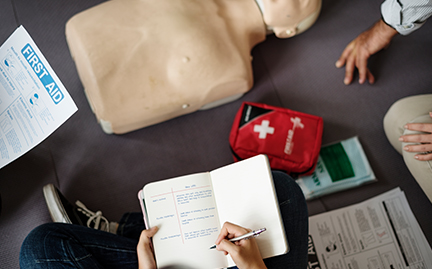
First Aid at Work
The course looks at the role of the first aider and an employer’s responsibilities in relation to first aid. This follows with practical activities covering a range of health emergencies such as choking, burns, bleeding, fractures as well as practising the recovery position as well as demonstrating the recovery position and cardio-pulmonary resuscitation (CPR).

Health and Safety
The course help learners to understand the Legal Framework and their roles and responsibilities in health and safety. It also covers principles of fire safety, infection control, COSHH, stress at work, managing risk and effective recording and reporting.

Infection Control

Mental Capacity Act & Deprivation of Liberty Safeguards

Moving and Handling Theory
One of 2 moving and handling courses, this one looking at the theory of caring for your back, identifying and assessing risks, roles and responsibilities of the worker and current legislation. Activities include discussing the spine and how it works and good practice guidance for manual handling.

Moving and Handling People (practical)

Record Keeping and Handling Information
The course helps staff to understand the legal framework relating to record keeping including the GDPR and their accountabilities and responsibilities within their role. Learners can practice effective record keeping and how to meet compliance.

Person Centred Approaches

Medicines Awareness
A comprehensive and detailed course, which is suitable for all staff who are involved in medication activities. It covers current legislation, policy and good practice including use of controlled medication in different settings, receipt, storage and disposal of medicines Activities include the use of a BNF to source different classes, forms and routes of medicines. Staff roles and responsibilities are explored in medication handling and record keeping in all types of settings, and how to safely administration different forms of medicines via different routes. Case studies are used to help learners identify remedial actions to take to reduce errors. Learners should have adequate knowledge to complete competency assessments when they return to their workplace.

Mental Health Awareness
Mental health awareness is something that is vital to everyone. This course is perfect to ensure you have a strong understanding of what mental health is and how to support people who may have a mental health issue. This course will cover the following:
- Describe the different categories of mental disorder.
- Risk factors of mental health disorder
- Discuss competing perspectives on the cause of mental distress.
- Mental health care and the challenges people face.
- Legislation in Relation to Mental Illness
- Outline strategies to promote mental health.

Care Certificate
The Care Certificate course is available for all care workers, healthcare assistants and social care support workers: –
- Who are new to the workplace or new to care
- Or existing staff requiring refresher training
The Care Certificate delivers public confidence in the provision of healthcare services and sets out a benchmark to which standards can be assessed. There’s two parts to the Care Certificate: –
- Training
- Demonstrating competence at work
Our ‘Care Certificate Training Course’ approved by Skill for Care delivers the knowledge care workers, healthcare assistants and social care workers need to help them towards achieving the Care Certificate.

Safeguarding Adults

Equality, Diversity and Inclusion in Health & Social Care

Mandatory Care Training
Our Care and Support Worker Mandatory Training is designed to meet the requirements of the UK Core Skills Training Framework (CSTF).
This comprehensive programme combines essential theory with practical skills, ensuring care staff gain up-to-date knowledge and confidence to deliver safe, person-centred care. Ideal for new and experienced staff alike, this training supports compliance, enhances professional practice, and promotes the highest standards in health and social care settings.

Breakaway Training
PMVA Training
The course is designed to follow BILD and RRN Standards for Organisations that may employ restrictive practices.